

Compare social media & content SaaS tools on verified pricing, limits and open, computed scorecards.
Added: 10/22/2026
An independent directory that compares social media scheduling, content creation and monetization tools using verified pricing and computed rankings.
Overview
Overview
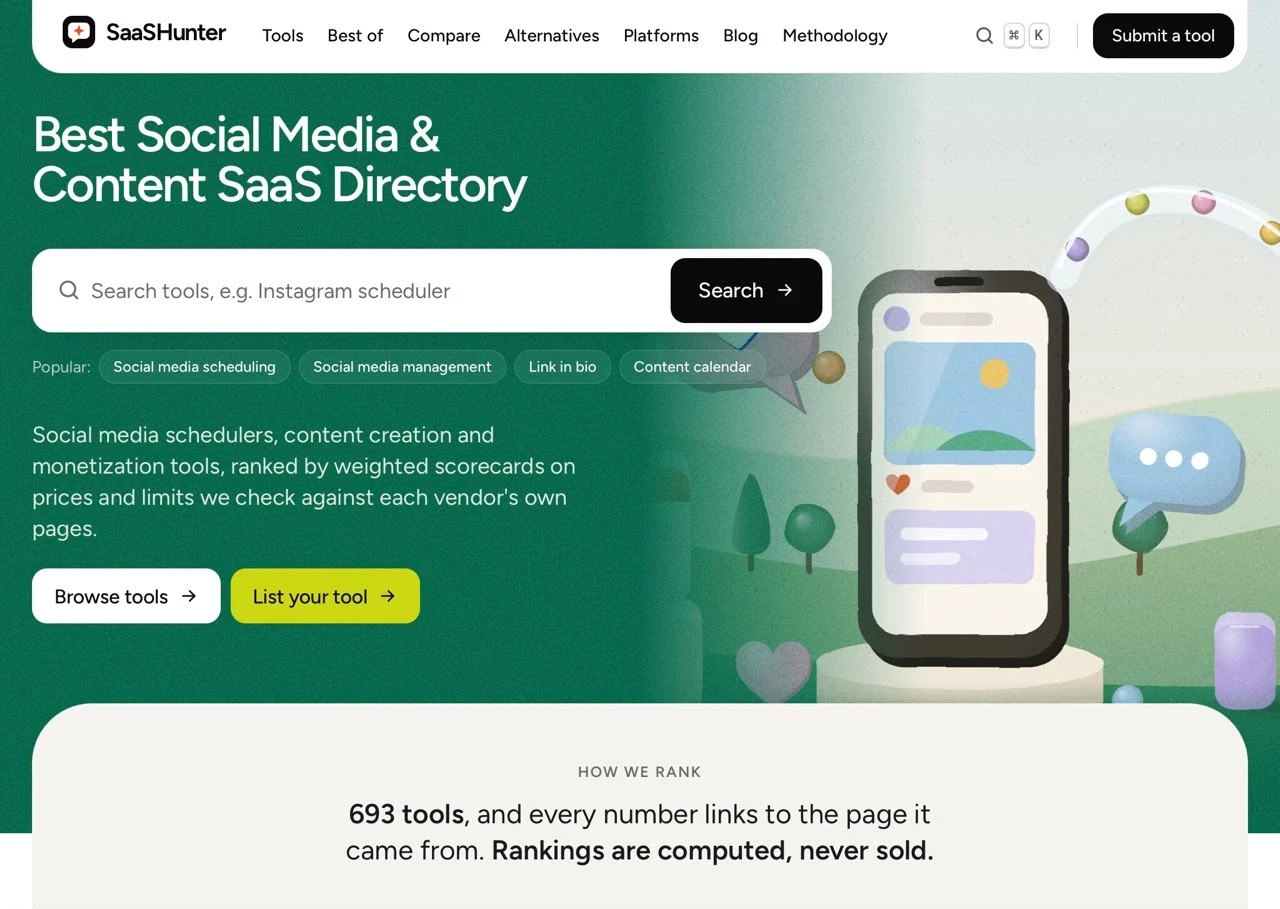
SaaSHunter is an independent, data-first directory for social media and content SaaS. Instead of recycling affiliate-friendly listicles, it collects prices, plan limits, features and platform support directly from each vendor's own pricing pages, docs and changelogs, then attaches a source link and a check date to every single value. Today it covers roughly 693 tools across scheduling, social media management, content calendars, AI writing and video, link-in-bio, newsletters and creator monetization, backed by more than 4,600 sourced facts and hundreds of computed rankings. The problem it solves is trust: buyers of social and content software are usually comparing stale review-site summaries, while SaaSHunter shows what a plan actually costs and includes today — and openly marks anything it could not verify as a dash (unknown) rather than guessing. Rankings are generated by published weighted scorecards and can never be bought, making it a practical research layer before you start a trial or a migration.
Key Features
- Source-linked facts, not opinions: Every price, seat limit, post quota or feature flag links to the vendor page it came from, plus the date it was checked, so you can re-verify it yourself in seconds.
- Published weighted scorecards: Each category has a visible scorecard listing the criteria, their weights and what each one measures. Every tool in a ranking is scored with the same code on the same criteria.
- Transparent "not ranked" state: Tools with too little verified data are explicitly listed as not ranked instead of being scored on guesswork, and unknown values appear as a dash — meaning unknown, never "no".
- Category and platform browsing: 200+ categories and platform pages (Instagram, TikTok, YouTube, LinkedIn, X and more) let you narrow from a broad need to a shortlist quickly.
- Side-by-side comparisons and alternatives: Dedicated compare pages and alternatives pages put competing tools next to each other on the same criteria, so switching decisions are based on identical dimensions.
- Computed best-of rankings: 205+ "best of" rankings rebuilt from the underlying data on every deploy, so lists never drift out of sync with the facts behind them.
- Searchable directory with fast lookup: A keyboard-driven search dialog (⌘K) and popular-category shortcuts get you from a vague task like "Instagram scheduler" to relevant tools fast.
- Open submission and labelling: Vendors can submit a tool, but paid placement is impossible; tools built by the team itself are scored by the same code and clearly labelled as theirs.
Target Users
- Solo creators and social media managers choosing a scheduler or link-in-bio tool and wanting to know real post limits and per-seat pricing before committing.
- Marketing teams and agencies running tool audits, consolidating overlapping subscriptions, or building a shortlist to present to finance with evidence attached.
- Growth and content leads comparing AI video, AI writing and content calendar tools for a specific platform or workflow.
- Founders and indie makers researching the competitive landscape before building or launching a social/content product of their own.
- Procurement-minded operators who need defensible, source-linked data rather than marketing copy when justifying a purchase.
Unique Selling Points
- Verification over aggregation: Most directories republish marketing blurbs. SaaSHunter goes to primary sources — vendor pricing pages, docs and changelogs — and timestamps each fact.
- No pay-to-rank, structurally: Rankings are computed by code from published weighted scorecards. There is no sponsored slot, no score for sale, and affiliate links (where present) are labelled and never influence position.
- Honest data semantics: Unverified values render as a dash meaning "unknown" rather than being defaulted to "not supported", which prevents the classic comparison-table distortion that makes rivals look weaker than they are.
- Reproducible rankings: Because rankings are rebuilt from the data on every deploy, you can trace any position back to the specific facts and weights that produced it.
- Depth in one niche: 693 tools focused on social media and content rather than a shallow general SaaS catalogue, with 200+ categories and platform-specific pages.
- Self-scoring discipline: Even the team's own products are run through the identical scoring code and labelled as theirs — a rare conflict-of-interest control in this space.
Pros and Cons
Pros
- Every number is traceable to a source page with a check date, which makes the data auditable and safe to cite internally.
- Rankings are computed from published, weighted scorecards, so there is no hidden editorial favouritism or sponsored placement.
- Unknown data is shown as a dash instead of a misleading "no", keeping comparisons fair between well-documented and poorly-documented vendors.
- Deep niche coverage (693 tools, 200+ categories, 4,600+ facts) with platform-specific and alternatives pages that support real decision-making.
- Free to browse with fast, keyboard-driven search and side-by-side comparison views.
Cons
- Verification is periodic, so a vendor that changes pricing or limits between checks can briefly appear out of date.
- Tools with thin public documentation get marked "not ranked", which means some niche or brand-new products are less visible than they might deserve.
- Dashboards, review-style user sentiment and hands-on test results are not the focus, so you still need trials to judge usability and support quality.
- Coverage is deliberately concentrated on social media and content SaaS, so it is not a general-purpose software directory.
Top Features
- Every price and plan limit is verified against the vendor's own pages, with a source link and check date.
- Rankings come from published weighted scorecards — computed by code, never bought or sponsored.
- Compare 693 social media and content tools side by side by category, platform and alternatives.
FAQ
Traffic Analysis
Monthly Visits
--
Avg. Duration
--
Global Rank
--
Bounce Rate
--
Alternatives to SaaSHunter
Domer AI
Domer AI is a free AI video generator that converts text or images into high-definition videos quickly, powered by models like Veo, Kling, and Seedance.

Orelon
Create cinematic videos from text or images with Orelon's AI video generator. Explore reusable effects, direct camera motion, and compare leading models.

LobbyClip
Lobby turns two photos into a 15-second AI duo video with themed Hotel Lobby scenes, MP4 audio, multiple aspect ratios, and one-time pricing from $1.49.

Unplain
Unplain converts docs and AI drafts (Word, Markdown, plain text, ChatGPT/Claude output) into branded, publish-ready PDFs like ebooks and lead magnets.

TrackMedia
TrackMedia is a social media content distribution engine that cross-posts to 20 networks and tracks clicks in real time.

ReelMind
ReelMind is an AI video generator and community for creating, editing, remixing, and sharing cinematic videos with models, templates, and trends.

Seedance
Create cinematic AI videos with Seedance 2.5 using flexible 4–30s 480p/720p workflows, plus Vidu Q3 Turbo for fixed 5s 720p clips.

PageTranslate.ai
AI-powered translation for PDF, DOCX, EPUB, and images in 50+ languages, with exact pricing before you pay and formatting preserved.