

Free browser-based tools to minify, compress, and optimize your website — no signup, no uploads.
Added: 10/3/2026
SpeeJax offers free browser-based tools to minify HTML, CSS and JavaScript, compress images, optimize SVGs and convert formats for faster websites.
Overview
Overview
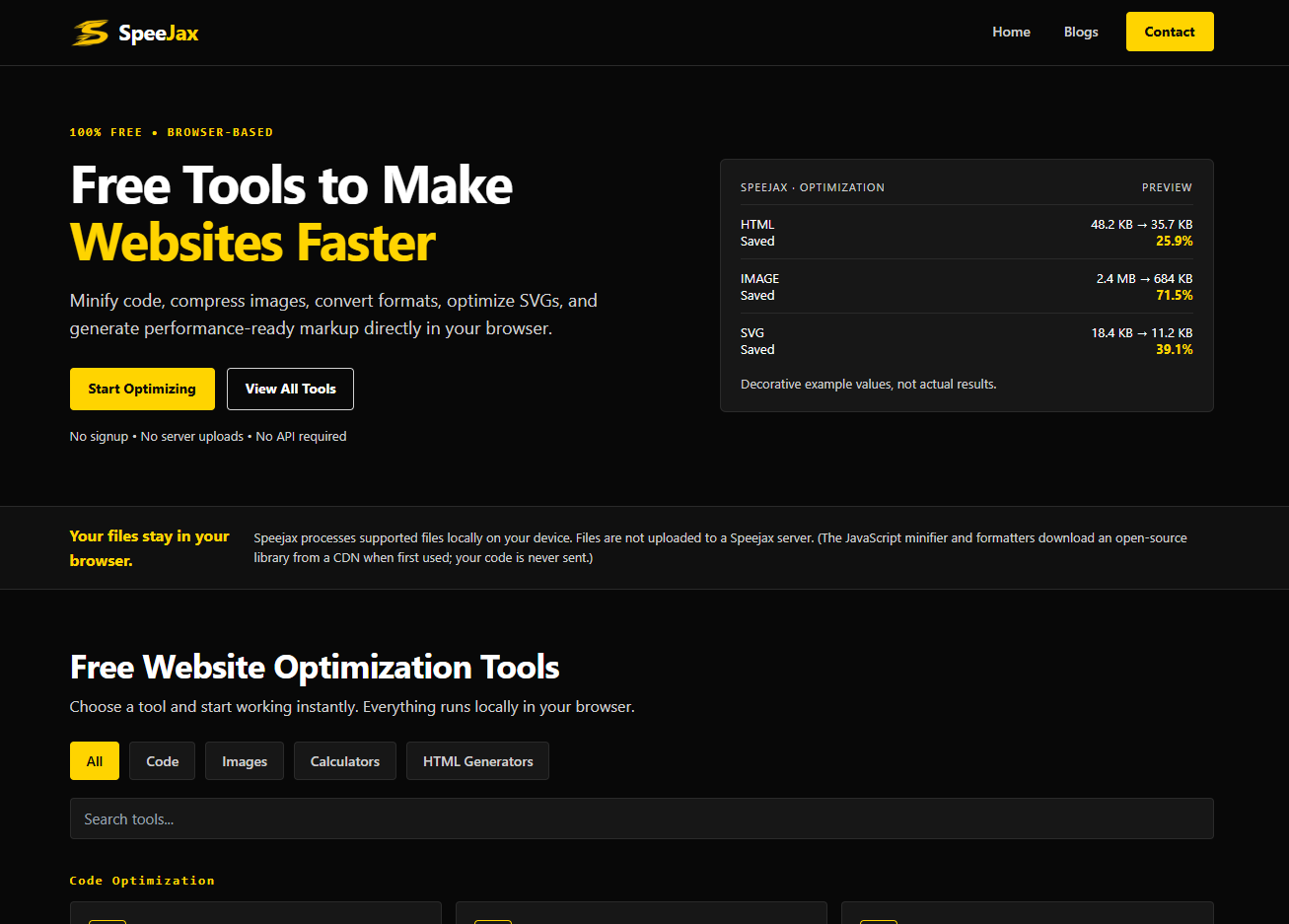
SpeeJax is a free, browser-based suite of website speed and optimization tools that helps developers, designers and site owners ship faster-loading pages without installing software or creating an account. It bundles minifiers for HTML, CSS and JavaScript, image compression, SVG optimization, format conversion and other performance-focused utilities into a single lightweight dashboard. The core promise is privacy and simplicity: supported files are processed locally in your browser rather than being uploaded to a SpeeJax server, so your code and assets never leave your device. It solves the common problem of hunting down a different free tool for every optimization task — and then worrying about whether that tool is storing or reselling your files.
Key Features
- HTML, CSS and JavaScript minifiers — Strip whitespace, comments and redundant characters to shrink source files and cut transfer size without changing behavior.
- Image compression — Reduce the file size of images before uploading them, with savings that often reach 60–75% on unoptimized assets.
- SVG optimization — Clean up exported SVG markup by removing editor metadata, unnecessary attributes and precision bloat.
- Format conversion — Convert between common image and asset formats so you can serve modern, lighter file types.
- 100% local processing — Files stay on your device; nothing is uploaded to a SpeeJax server (the JS minifier and formatters pull an open-source library from a CDN on first use, but your code is never sent).
- Instant, searchable tool grid — A category-filtered, searchable list of tools means you can jump straight to what you need with no onboarding.
- No signup or API key required — Open the page and start optimizing; there are no accounts, quotas or paid tiers.
- Performance guides and FAQ — Supporting documentation explains the underlying web-performance concepts behind each tool.
Target Users
- Front-end and full-stack developers who want a quick pre-deploy pass over markup, styles and scripts without wiring up a build step.
- WordPress, Shopify and no-code site owners who need to shave kilobytes off a page but don't have a formal toolchain.
- Web designers and freelancers delivering client sites who need reliable, free optimization utilities they can use on any machine.
- SEO and marketing specialists improving Core Web Vitals and page-load metrics to support rankings and conversions.
- Privacy-conscious teams handling proprietary code or unreleased assets who can't risk uploading files to a third-party server.
Unique Selling Points
- Genuinely local processing. Many "free online" optimizers upload your files to a server. SpeeJax explicitly keeps supported files in the browser, which matters for proprietary code and client NDAs.
- A suite, not a single tool. Minification, image compression, SVG cleanup and format conversion live in one place, so you stop juggling five different bookmarks.
- Zero friction. No account, no email gate, no API key, no credit card, no file-size paywall — the barrier to entry is literally opening the page.
- Runs anywhere with a browser. Because it's browser-based, it works on Windows, macOS, Linux and ChromeOS identically, with nothing to install or update.
- Built by people focused on page speed. The surrounding guides and FAQ are oriented toward real performance outcomes rather than just being a generic file utility.
Pros and Cons
Pros
- Completely free with no signup, quota or hidden paid tier.
- Local, in-browser processing keeps sensitive code and assets private.
- Consolidates several optimization tasks — minify, compress, convert, optimize — into one dashboard.
- Works instantly on any OS with a modern browser; no installation or maintenance.
- Clear, documented behavior around the CDN-loaded library used by the JS minifier and formatters.
Cons
- Browser-based tooling can be slower than native CLI tools on very large files or batches.
- Some tools depend on an open-source library fetched from a CDN on first use, so a connection is required the first time.
- Advanced build-pipeline features (bundling, tree-shaking, source maps, CI integration) are out of scope — this is a manual optimization aid, not a replacement for a bundler.
Top Features
- Minify HTML, CSS and JavaScript in seconds to cut page weight
- Compress images and optimize SVGs with no upload to any server
- Free forever — no signup, no API key, no file-size limits
FAQ
Traffic Analysis
Monthly Visits
--
Avg. Duration
--
Global Rank
--
Bounce Rate
--
Alternatives to Speejax

AIReiter
AIReiter unifies leading image, video, and text models with one API key, one billing system, and one developer workflow.

MCPALL
MCPALL is an MCP server directory with original guides, install commands, and client setup for Claude, Cursor, VS Code and Windsurf.

DSH Hub
Browse 325 verified DeepSeek Harness plugins and clients — vision, terminal, marketplace, and UI tools — each linked to a public GitHub repo.

WebsiteCopier
Back up your website as real static files

Viston AI
Viston AI delivers custom AI solutions and development services, with live interactive demos that show how AI transforms real business operations.

Toolbantu
Fast, simple online tools for images, developers, text, files, security, and everyday digital tasks.

Ecommerce Data API
面向 Amazon 商品、关键词、市场、销量、评论、流量和商标研究的电商数据 API,支持开发者构建选品研究与自动化工作流。

SightRadar
Production-grade face recognition API to index, search, compare and detect faces — drop-in compatible with AWS Rekognition.