

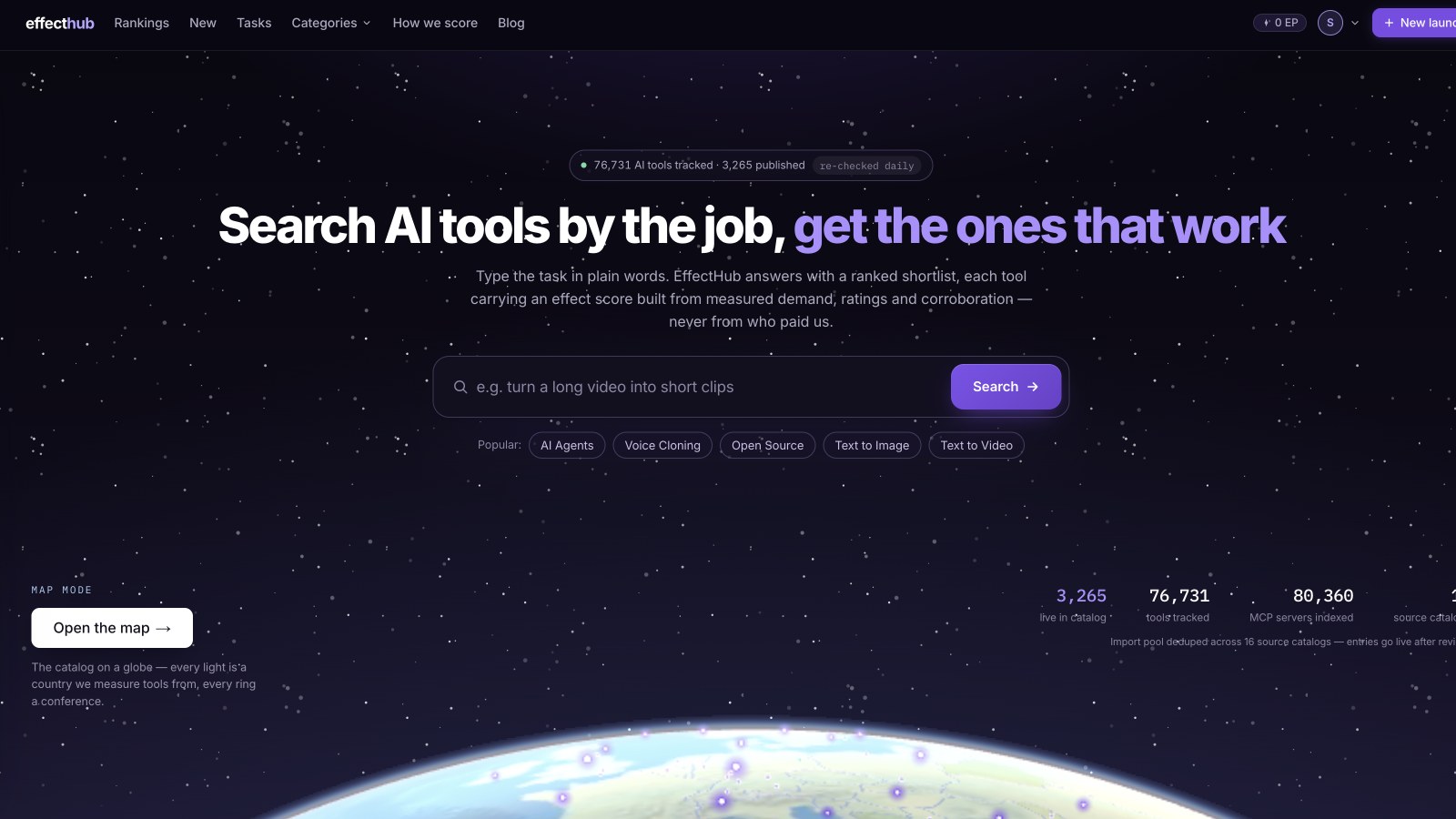
76,731 AI tools tracked, 3,312 verified live — search by the job you need done, not the hype.
Added: 10/17/2026
An AI tools catalog that re-checks every listing daily — showing live status, pricing, and alternatives, ranked by an effect score that never comes from paid
Overview
Overview
EffectHub is a curated AI tools catalog built around a single promise: every listing is re-checked so you know whether a tool is still alive, when it was last verified, what it costs, and what the alternatives are. Instead of browsing an undifferentiated wall of submissions, you describe the job in plain words — for example, "turn a long video into short clips" — and EffectHub answers with a ranked shortlist.
Ranking is driven by an effect score built from measured demand, ratings, and corroboration across sources. The site states explicitly that this score never comes from who paid them. Coverage is broad and honest about its funnel: 76,731 AI tools tracked, of which 3,312 are published and live in the catalog, plus 80,360 MCP servers indexed, all deduped from 16 source catalogs before entries go live after review.
The catalog is organized into 23 categories with live counts, including Image Generation & Editing (291), Marketing & Growth (291), Video (269), Chatbots, Assistants & Agents (251), Text & Writing (235), Audio, Voice & Music (218), Design & Creative (218), Coding & Development (205), Productivity & Workflow (142), Education & Learning (140), AI Infrastructure & Dev Platforms (130), Business, Finance & Legal (127), and more.
A distinctive Map mode plots the industry on an interactive globe — roughly 2,000 tools across 65 countries plus hundreds of events — with filters for tools, past events, events on now, and upcoming events, and category filters spanning Engineering, Data, DevOps, AI, Security, Product, and Design.
Key Features
- Task-first search: A plain-language search bar ("Search AI tools by task") with popular entry points such as Open Source, AI Agents, Voice Cloning, Text to Image, and Text to Video.
- Effect score ranking: Shortlists are ordered by a score derived from measured demand, ratings, and corroboration — with an explicit no-pay-to-rank policy.
- Liveness and verification data: Each listing carries whether the tool is still alive, its last verification date, its pricing, and its alternatives.
- Rankings, New, and Tasks sections: Dedicated navigation for top-ranked tools, newly added launches, and job-to-be-done browsing (e.g. /ai-for/open-source, /ai-for/ai-agents).
- Category taxonomy with counts: 23 parent categories from AI Infrastructure & Dev Platforms and Coding & Development through to Lifestyle & Personal, Health, Fitness & Wellbeing, and Entertainment, Gaming & Social.
- Interactive globe (Map mode): Click any light to see what is built in that country; toggle Tools, Past, On now, and Upcoming events; filter by discipline; search tools, events, and categories directly on the globe.
- Country and event intelligence: Top build countries surfaced as United States (1,002), United Kingdom (144), Singapore (78), India (68), Germany (65), Canada (57), France (52), China (49), Australia (45), Israel (40) — plus a "Next up" conference feed (X-Ops Conference Dubai, Joomla! World Conference, MIT AI Conference, Global Summit on Data Science and Cloud Computing, TechEx Europe).
- Saved tools: An account area (/account/saves) to bookmark and track tools you care about.
- Submission pipeline: A "New launch" / apply flow for makers to get a tool into the review queue.
- Editorial layer: A "How we score" page and a blog documenting methodology and findings.
- Clearly labeled sponsorship: Paid placements are marked as Sponsored with the note that they do not change any ranking on the site (currently Seonix, an SEO and AI-search content automation tool).
- Scale transparency panel: Live counters for live-in-catalog, tools tracked, MCP servers indexed, and source catalogs.
Target Users
- Builders and product teams choosing an AI vendor or API who need to know whether a tool still exists before integrating it.
- Marketers, SEO and growth operators scanning the Marketing & Growth, SEO, Advertising, and Social Media tooling space.
- Creators and designers working across Image Generation & Editing, Video, Design & Creative, and Audio, Voice & Music.
- Developers and AI engineers evaluating Coding & Development, AI Infrastructure & Dev Platforms, and MCP servers.
- Founders and indie makers doing launch and competitor research, including checking where tools are built geographically.
- Researchers, analysts, and procurement/ops people who need pricing and alternative comparisons in one place.
- Event-goers and community organizers using Map mode to find AI conferences and meetups by country and date.
Unique Selling Points
- Verification over volume. The headline metric is not how many tools were scraped but how many are re-checked daily and confirmed alive — 3,312 published out of 76,731 tracked.
- Independence you can audit. The effect score is described as coming from measured demand, ratings, and corroboration, "never from who paid us," and sponsored slots are labeled as not affecting rankings.
- Deduplication across 16 source catalogs. The import pool is merged and deduped, then gated by review before going live — reducing the duplicate-listing problem that plagues most directories.
- Job-to-be-done search instead of keyword guessing. You type the outcome, not the brand name.
- Geographic and event context in one interface. Map mode connects tools, countries, and conferences, which almost no competing catalog does.
- Free, fast, no-signup browsing with optional accounts only for saving tools.
Pros and Cons
Pros
- Liveness status and last-verified dates solve the biggest pain in AI tool discovery: dead links and abandoned products.
- Transparent, documented scoring methodology plus clearly marked sponsorships build trust.
- Strong taxonomy with 23 categories and real counts, making large segments like Image Generation & Editing (291) or Video (269) navigable.
- Deduplication from 16 source catalogs improves result quality versus raw aggregators.
- Map mode adds country-level and event-level intelligence that is genuinely hard to find elsewhere.
- Saved tools, New, Rankings, and Tasks give multiple complementary discovery paths.
- Free to use and fast; no paywall in front of the catalog.
Cons
- Only 3,312 of 76,731 tracked tools are published, so the live catalog is a small slice of what the site says it monitors.
- Map-mode figures are stated inconsistently in places (2,000 tools / 451 events versus 3,312 live tools / 691 events), which can be confusing.
- Sponsored placements appear near the top of the experience, even though they are labeled.
- Pricing and status accuracy depends on third-party sources and periodic re-checks, so newly changed pricing can lag between verification cycles.
- Coverage skews heavily to the United States (1,002 of the mapped tools), so regional tool discovery outside major hubs is thinner.
- No visible depth of user-generated reviews or hands-on testing narratives; the score is aggregate rather than editorial review.
- Event listings link out to third parties and are marked nofollow, so EffectHub is not the source of truth for schedule changes.
Top Features
- Task-first plain-language search that returns a ranked shortlist instead of a keyword dump
- Effect score ranking built from measured demand, ratings, and corroboration — never from paid placement
- Liveness status and last-verified date on every listing, re-checked daily across 76,731 tracked tools and 80,360 indexed
FAQ
Traffic Analysis
Monthly Visits
--
Avg. Duration
--
Global Rank
--
Bounce Rate
--
Alternatives to EffectHub

Tapetide
Tapetide is an AI research assistant for about 8,000 NSE and BSE stocks, covering financials, quarterly results, FII/DII flows, shareholding, screeners, IPO, M

Satcove
Satcove queries Claude, GPT, Gemini, Mistral, Perplexity, and Grok together to deliver one consensus verdict with an agreement score.

ExplainViz
ExplainViz is an AI scientific figure maker that turns research findings, variables, theories, and abstracts into editable, publication-ready diagrams and posts

Unit Converter for Science
Accurate unit conversions for science and engineering across 11 categories, with formulas, conversion steps, and factor explanations.

Build or Skip
Build or Skip ranks public payment signals and tip data month by month so indie developers can spot products that are already growing before they build.

AI Hunt Base
AI Hunt Base is a curated directory of AI tools, offering independent reviews, useful comparisons, and recommendations organized by real-world use cases.

SubmitMap
SubmitMap offers an exhaustive directory of 829 launch platforms, detailing eligibility, submission steps, and realistic outcomes for your product.

lordof my steries guide
A comprehensive game guide for the Lord of Mysteries MMORPG, offering detailed strategies for all 22 Beyonder pathways, boss encounters, and character builds.