

Find products already making money before you build — ranked by payment signals, tips, and momentum.
Added: 9/18/2026
Build or Skip ranks public payment signals and tip data month by month so indie developers can spot products that are already growing before they build.
Overview
Overview
Build or Skip is a product-opportunity research platform aimed at one question indie founders ask too late: is anyone actually paying for this? Instead of guessing at demand from keyword volume or vibes, it aggregates publicly visible payment signals — checkout activity, tipping data, site intelligence and backlink resources — and ranks products month by month so you can see what is growing, what has staying power, and what is worth a closer look.
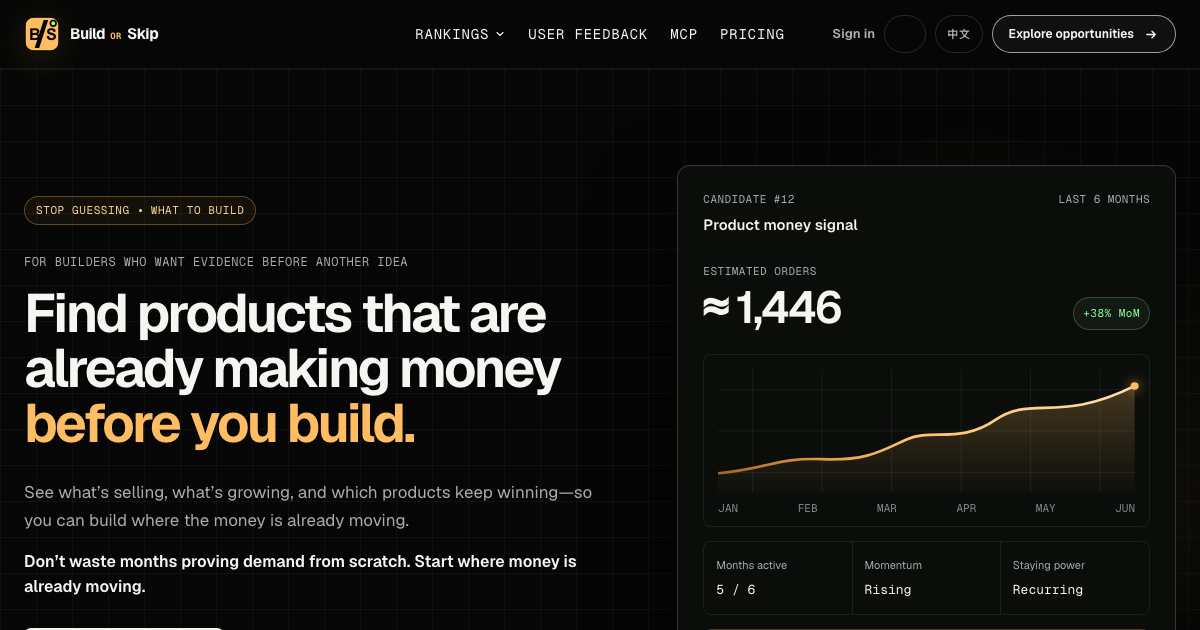
The dataset is broad: 50k+ money-making sites, 15,000+ money-making AI tool sites, 300+ Buy Me a Coffee sites, 200+ comment backlinks and 400+ AI tool submission backlinks, all browsable through dashboard rankings, a Chrome extension, a REST API and an MCP server for AI clients. A live "opportunity snapshot" on the homepage shows the shape of the data you get: roughly 1,446 payment signals, +38% month-over-month, 5 of 6 months active, momentum "Rising" and staying power "Recurring".
The core promise is positioning: don't spend months proving demand from scratch — start where money is already moving.
Key Features
- New site revenue ranking — surfaces newly registered domains that show payment signals, with monthly candidate lists, site profiles and category context so you can catch products early.
- Product revenue ranking — filter by product area, payment channel, DR, registration date and payment signals, then compare six-month momentum side by side.
- Tip revenue ranking — compares publicly visible Buy Me a Coffee tip amounts, active months and six-month amount trends as an alternative demand signal.
- Comment backlink library — collected comment articles organised by domain and review date, with a direct link to the original page so you can evaluate it yourself (continuously updated).
- AI tool backlink library — AI directories and resource sites with submission URL, fee requirement, reciprocal-link requirement and last-check date (continuously updated).
- Opportunity snapshot metrics — months active, momentum (rising / flat / falling) and staying power (recurring / one-off) make a product's trajectory readable at a glance.
- API — query DR, domain registration, monthly traffic and structured homepage data through a single account API.
- MCP server — connect supported AI clients to browse the dataset catalog, discover products, read site snapshots and check usage.
- Chrome Extension — bring the ranking data into your browsing flow.
- Bilingual interface — English and Simplified Chinese locales, with daily updates on backlink resources and calendar-month reporting on revenue rankings.
Target Users
- Independent developers and solo makers who want to build a product but refuse to burn months on unvalidated demand.
- Small startup teams and founders doing pre-build market research and competitive scanning.
- Indie hackers exploring AI tool niches, who need to know which AI products are already monetising.
- SEO and growth operators farming the comment and AI-directory backlink libraries for link-building opportunities.
- Data-driven builders and AI power users who prefer to pull signals via the API or MCP rather than click through dashboards.
Unique Selling Points
- Payment signals over guesswork. Rankings are built on observable commercial activity rather than estimated search volume, so a candidate has already shown money moving.
- Time-series, not snapshots. Six-month views with active-month counts and momentum labels separate a one-off spike from a product that keeps winning.
- One tool, three research layers. Revenue rankings, tip data, site intelligence (DR, registration, traffic) and backlink resources live in the same workspace.
- Machine-readable by design. A documented API and an MCP server mean the data plugs into your own tooling or AI assistant, not just a web UI.
- Honest about freshness. Backlink resources update daily; revenue rankings follow calendar-month reporting; other site data displays its relevant date — you always know how current the evidence is.
Pros and Cons
Pros
- Directly answers the "what should I build?" question with ranked, filterable commercial evidence.
- Combines new-domain discovery with established product rankings, so you can hunt early-stage and proven opportunities in the same place.
- Momentum, active months and staying-power labels make trend reading fast, even for non-analysts.
- Backlink libraries (comment + AI tool submission) double as an SEO/link-building resource with fee and reciprocal-link requirements spelled out.
- API, MCP and Chrome extension cover dashboard users, developers and AI workflows alike.
- Bilingual UI and transparent data-freshness statements reduce friction for international users.
Cons
- The signals are research signals, not verified orders or revenue — Build or Skip states this explicitly, so absolute revenue figures should not be treated as fact.
- Freshness varies by dataset; revenue rankings lag by calendar month while only backlink resources refresh daily.
- Coverage skews toward sites that surface publicly (payment pages, Buy Me a Coffee, AI tool directories), so quiet B2B or enterprise products may be underrepresented.
- Getting the most value from the API/MCP paths assumes some technical comfort.
- Full access to rankings and data is tied to an account and pricing plan, so budget-conscious makers should check the current tiers before committing.
Top Features
- New site revenue ranking for newly registered domains showing payment signals
- Product revenue ranking with filters for product area, payment channel, DR, registration date and 6-month momentum
- Tip revenue ranking based on publicly visible Buy Me a Coffee tip amounts and trends
FAQ
Traffic Analysis
Monthly Visits
--
Avg. Duration
--
Global Rank
--
Bounce Rate
--
Alternatives to Build or Skip
Wisegrid
Wisegrid transforms familiar spreadsheets into dynamic work management tools, offering live dashboards, automations, and AI capabilities for teams.

Aback Tools - Free Online Tools & Utilities
Professional-grade free online tools for everyone. Convert files, format content, and streamline workflow.
Messy2Sheet
Messy2Sheet converts messy documents like PDFs, scans, and spreadsheets into usable Excel or CSV files by letting users define the desired table structure.

JPG to Excel Converter
Convert JPG images to editable Excel spreadsheets with AI-powered accuracy, online verification, and easy editing.

Seedance2Prompt
Discover and share high-quality Seedance prompts for AI video generation. Unlock your creativity with community-driven tools.

DistributeNow
DistributeNow finds relevant customer questions, creates helpful answers, adds natural brand mentions, and distributes them to relevant platforms.

Product Launch Checklist
Free interactive product launch checklist for SaaS, apps, AI tools and more — every step explains why it matters and when to skip it.

Music Visualizer
Create audio-reactive music visualizer videos online with 19 presets, live local preview, and cloud-rendered H.264 exports up to 2K.